Food cost tracking
A Practical Restaurant Food-Cost Review From Invoice to Menu Item
Learn how invoice prices become usable ingredient costs, recipe estimates, and menu-item decisions without confusing estimates with accounting COGS.
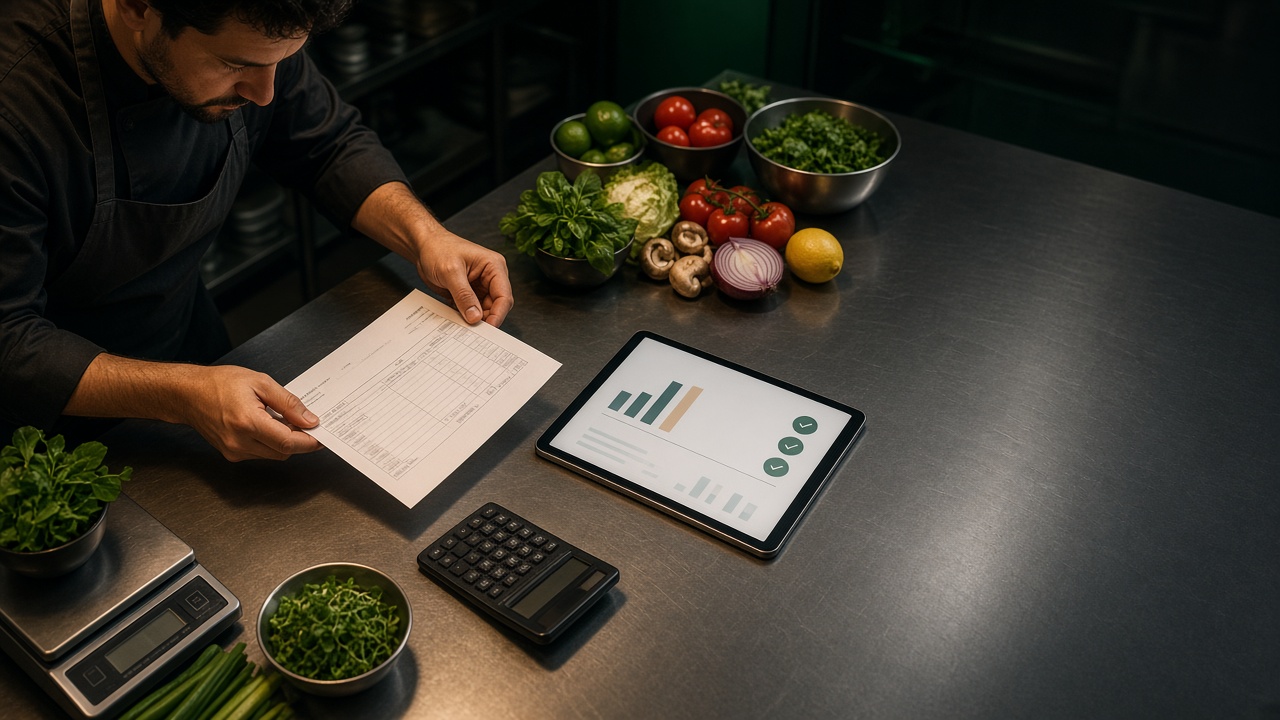
Restaurant operators often notice cost changes in fragments. A case of wings costs more this week. Cheese moves again. A menu item still sells well, but nobody is sure whether its margin resembles the number used when the price was set.
The information needed to investigate is usually available. The difficulty is connecting an invoice package to a kitchen unit, that unit to an approved recipe, and the recipe to the current menu price.
A useful food-cost workflow makes those connections visible and reviewable. It does not pretend that an estimate built from recipes is the same as accounting cost of goods sold or a physical inventory.
Begin with the invoice as evidence
Supplier invoices provide the current purchase price, vendor item description, quantity, and package information. Preserve that source record before normalizing anything.
For every line, the operator should be able to answer:
- Which vendor supplied it?
- What exact package was purchased?
- How many cases or units were billed?
- What was the line price?
- Which ingredient in the restaurant’s catalog does it represent?
- Was the match reviewed or automatically suggested?
Keeping the original description beside the normalized ingredient makes future review easier. “Tomatoes” is not enough if the invoice actually describes a case containing multiple cans at a stated size.
Translate purchase packages into usable units
Recipes rarely use “one case.” They use an ounce, pound, gallon, each, slice, or portion. That makes package interpretation one of the most important steps in costing.
Suppose an invoice lists a case with six five-pound units. The total usable purchase quantity is thirty pounds before any yield adjustment. Dividing the case price by thirty produces a purchase cost per pound. A recipe using eight ounces would use half of that per-pound amount before considering trim or waste.
Three values deserve separate attention:
- Pack structure: how many inner containers or units are present.
- Unit size: the weight, volume, or count represented by each unit.
- Usable yield: the portion available to the recipe after trim, cooking loss, or waste.
If the package description is ambiguous, flag it for review. A confident-looking calculation built on the wrong pack interpretation is less useful than an incomplete line that clearly asks for a person’s decision.
Maintain one ingredient catalog
Vendors describe the same ingredient differently. Abbreviations, brand names, pack notation, and changing vendor codes can create duplicates unless the restaurant maintains a normalized catalog.
The catalog should preserve vendor aliases while mapping them to a restaurant-friendly ingredient name and standard costing unit. Historical prices then belong to the ingredient rather than disappearing inside individual invoice files.
This makes two practical reviews possible:
- Compare the current normalized price with recent purchases.
- Find menu items affected by a meaningful ingredient-price change.
Price history should prompt a question, not automatically dictate a menu-price change. A temporary substitution and a sustained market movement deserve different responses.
Build recipes that match actual portions
A recipe-cost estimate is only as useful as its quantities. Use the portion the kitchen is expected to serve, not the amount that happens to fit neatly into an invoice unit.
For each recipe line, record:
- Ingredient
- Quantity per base portion
- Unit
- Yield assumption when relevant
- Optional components that are actually included in the normal sale
Review sauces, garnishes, cooking oil, sides, disposables, and modifiers according to how the restaurant wants to use the estimate. Consistency is more important than pretending every operation follows the same convention.
Keep AI suggestions behind human approval
AI can help propose likely ingredients for a menu item or interpret an invoice description. It does not know the restaurant’s actual scoop, trim practice, substitution, or plating decision unless a person supplies and verifies that information.
For that reason, suggested recipe lines should remain separate from reported cost until an authorized user approves them. The review should ask whether the ingredient exists in the catalog, whether the quantity reflects one serving, and whether the selected unit can be converted reliably.
An incomplete approved recipe is not automatically better than a visible draft. Confidence should reflect what has truly been reviewed.
Calculate the operating estimate
For a simple operating view:
Estimated recipe cost is the sum of approved ingredient quantities multiplied by their current normalized unit costs.
Estimated food-cost percentage is estimated recipe cost divided by the current menu price, multiplied by 100.
Estimated gross profit is the menu price minus estimated recipe cost.
These figures help compare menu items and identify where review is needed. They do not include every labor, occupancy, processing, waste, discount, or inventory factor that affects restaurant profitability.
Establish a review rhythm
A manageable cadence is better than an ambitious spreadsheet that is abandoned.
- Review newly ingested invoices and unresolved matches each week.
- Investigate material price changes rather than every small movement.
- Approve or correct recipe suggestions before relying on reports.
- Revisit high-cost and low-confidence menu items monthly.
- Compare operating estimates with bookkeeping and physical inventory results.
Toasted Apps food-cost tracking connects invoice PDFs, ingredient price history, reviewable recipes, and Toast menu prices in one workflow. It remains an operating estimate, not a replacement for accounting or inventory controls.
Start a free trial and review one menu category using current supplier information.
This article was prepared with AI assistance and reviewed against Toasted Apps product facts and first-hand restaurant operating experience.