Food cost tracking
From Case Price to Plate Cost: A Pack-Size Conversion Workflow
Invoice prices rarely match the units used on recipe cards. This workflow turns cases, packs, pounds, and counts into consistent ingredient costs your kitchen can review.
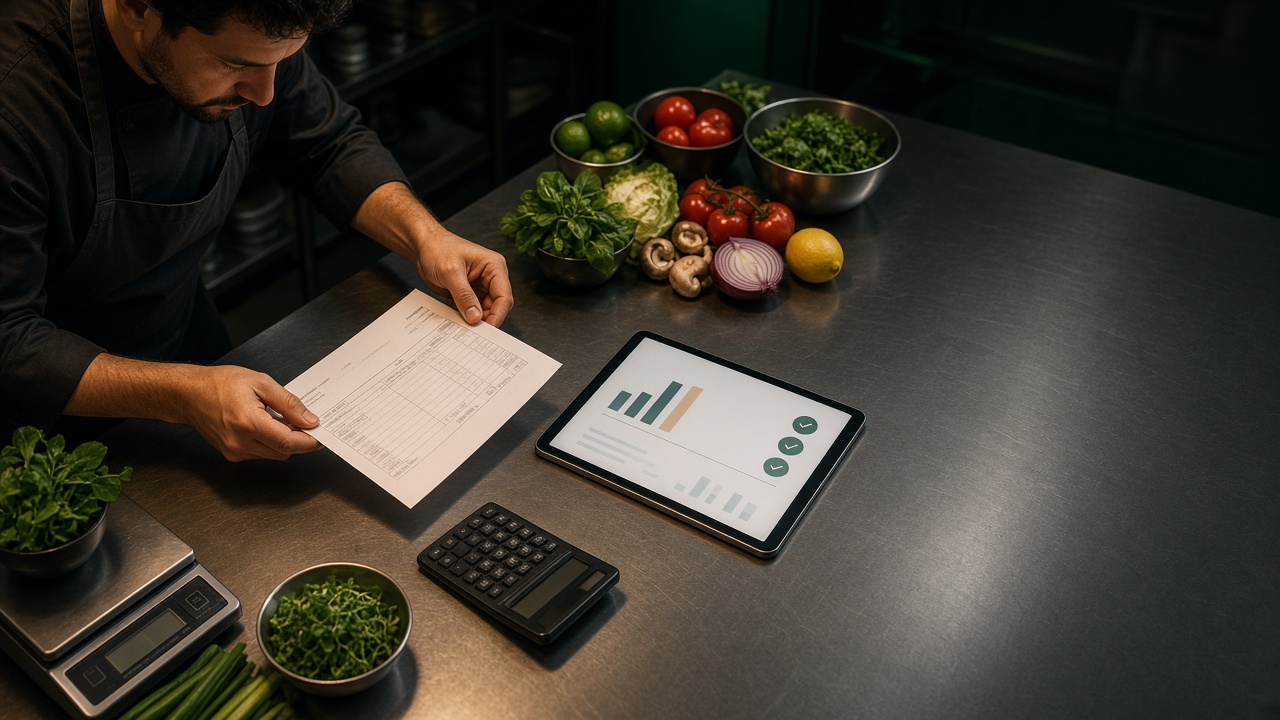
An invoice might price chicken by the case, oil by the jug, and tortillas by the pack. Your recipes may use ounces, fluid ounces, or individual pieces.
Getting from one to the other is not complicated math. The challenge is documenting each step so a new invoice, pack-size change, or vendor substitution does not quietly distort the cost of every affected menu item.
Start with the pack hierarchy
Read each invoice line as a hierarchy rather than a single quantity:
Case → inner pack → purchase unit → recipe unit
For example:
- 1 case
- 4 bags per case
- 5 pounds per bag
- 16 ounces per pound
That case contains:
4 bags × 5 pounds × 16 ounces = 320 ounces
If the case costs $72, the as-purchased cost is:
$72 ÷ 320 ounces = $0.225 per ounce
A recipe using 6 ounces would carry an ingredient cost of:
6 ounces × $0.225 = $1.35
Write out the hierarchy even when the conversion feels obvious. The written path makes it much easier to catch a mistaken pack count later.
Choose one recipe unit for each ingredient
Before calculating costs, decide how the ingredient will be measured in recipes. A practical unit should match how the kitchen portions the product.
Common choices include:
| Ingredient type | Practical recipe unit |
|---|---|
| Meat, cheese, and dry goods | Ounce or gram by weight |
| Sauces and oils | Fluid ounce, milliliter, or tested portion |
| Buns, tortillas, eggs, and packaged items | Each |
| Produce | Ounce by usable weight or each |
| Garnishes | Gram, ounce, each, or standardized portion |
Consistency matters more than choosing the theoretically perfect unit. If one recipe records sliced cheese by the ounce and another records the same cheese by the slice, someone must maintain a reliable slice weight or the costs will drift apart.
Create a short ingredient-unit dictionary for the team. For example:
- Ground beef: ounces by raw weight
- Fry oil: fluid ounces
- Burger buns: each
- Sliced pickles: ounces after draining
- Wing sauce: fluid ounces
This gives recipe builders and invoice reviewers the same frame of reference.
Use the invoiced quantity, not the product nickname
Descriptions such as “large,” “jumbo,” “foodservice pack,” or “#10 can” are not enough to establish a recipe-ready quantity. Confirm the actual count, net weight, or volume shown on the invoice, case label, or product specification.
For every ingredient, capture:
- Invoice description
- Vendor item number
- Case price or extended line cost
- Number of inner packs
- Quantity in each inner pack
- Final recipe unit
- Yield assumption, if applicable
- Date or invoice associated with the cost
Do not assume that a replacement item has the same pack size as the item it replaces. A lower case price can still produce a higher unit cost if the case contains less usable product.
Calculate as-purchased unit cost
The basic formula is:
As-purchased unit cost = invoice cost ÷ total quantity in recipe units
Example: a multi-bag case
Assume a hypothetical case of shredded cheese costs $68 and contains four 5-pound bags.
- Find the total pounds:
4 × 5 = 20 pounds - Convert to ounces:
20 × 16 = 320 ounces - Find the cost per ounce:
$68 ÷ 320 = $0.2125
Rounded to four decimal places, the cheese costs $0.2125 per ounce. A 3-ounce recipe portion costs about $0.64 before considering waste or overportioning.
Example: products purchased by count
Assume a case of 240 tortillas costs $36.
$36 ÷ 240 = $0.15 per tortilla
If an order uses three tortillas:
3 × $0.15 = $0.45
Count-based costing works well only when the count is dependable. If case counts or piece sizes vary, record that limitation rather than treating the result as exact.
Example: cans or bottles within a case
Assume a $42 case contains six cans, and each can has a verified net quantity of 105 ounces.
- Total quantity:
6 × 105 = 630 ounces - Unit cost:
$42 ÷ 630 = $0.0667 per ounce
Do not use the number of cans alone if recipes are portioned by weight or volume. The contents per can are part of the conversion.
Adjust for usable yield when prep creates loss
As-purchased cost describes what came through the back door. Edible-portion or usable cost reflects what remains after trimming, peeling, draining, or other normal preparation loss.
The formula is:
Usable unit cost = as-purchased unit cost ÷ yield percentage
Suppose a 20-pound case of produce costs $36. The case contains 320 as-purchased ounces:
$36 ÷ 320 = $0.1125 per as-purchased ounce
If a measured prep test finds an 85% usable yield:
$0.1125 ÷ 0.85 = $0.1324 per usable ounce
A recipe using 5 usable ounces would cost about:
5 × $0.1324 = $0.66
Without the yield adjustment, the same portion appears to cost about $0.56. That ten-cent gap can become meaningful across many orders.
Run a simple yield test
Use a process the kitchen can repeat:
- Record the ingredient's starting weight.
- Prep it according to the restaurant's normal procedure.
- Record the usable finished weight.
- Divide usable weight by starting weight.
- Repeat when product specifications or prep methods change.
For example:
13.6 pounds usable ÷ 16 pounds purchased = 85% yield
Yield is an operating assumption, not a permanent product fact. Different specifications, cooks, and prep standards can produce different results.
Keep weight, volume, and count separate
One of the easiest ways to create a bad conversion is to treat unlike units as interchangeable.
- Weight measures mass: pounds, ounces, kilograms, and grams.
- Volume measures space: gallons, quarts, cups, fluid ounces, liters, and milliliters.
- Count measures individual pieces.
An ounce by weight is not automatically the same as a fluid ounce. Converting a sauce from pounds to fluid ounces requires a reliable product-specific density or a measured kitchen test.
Likewise, converting a case of produce into “each” requires a dependable piece count. If the count varies substantially, costing by weight may provide a more stable basis.
When the purchase and recipe units do not match, choose one of these approaches:
- Change the recipe to use the purchased measurement type.
- Obtain a reliable product specification.
- Run and document a kitchen measurement test.
- Use a standardized scoop, ladle, or container and measure its actual portion.
Avoid a guessed conversion simply because it makes the spreadsheet complete.
Handle catch-weight products with the billed weight
Some products arrive at a variable actual weight. In those cases, the case description may show a target or approximate weight while the invoice charges for the specific delivered weight.
Use:
Extended line cost ÷ actual billed weight
If the recipe is written in ounces, convert the billed pounds to ounces before dividing. Do not calculate from the expected case weight when the vendor billed a different quantity.
Also verify whether the invoice displays both a price per pound and an extended total. A unit-price field entered in place of the line total can throw off the calculation immediately.
Decide how to treat discounts, fees, and credits
Restaurants need a consistent policy for amounts that sit outside the basic item price.
Questions to settle include:
- Will item-specific discounts reduce that ingredient's cost?
- Will delivery or fuel charges be allocated across products or tracked separately?
- How will credits for shortages or damaged products be reflected?
- Does the invoice line include tax or another charge that should not be assigned to recipe cost?
There is no single operational treatment that fits every restaurant. The important step is to document the policy and apply it consistently. Confirm the accounting treatment with the professionals responsible for your books.
Build a review queue for ambiguous invoice lines
Not every invoice description provides enough information to calculate a trustworthy unit cost. Flag the line for review when:
- The pack notation is unclear.
- The billed quantity differs from the case description.
- A vendor substitution changes the size or specification.
- Net weight is missing.
- The product is purchased by weight but portioned by volume.
- A yield assumption has never been tested.
- A discount or credit cannot be tied to a specific item.
- The calculated unit cost changes sharply without a clear reason.
A temporary “needs review” status is safer than silently approving a guessed conversion.
Use a repeatable conversion worksheet
A compact worksheet can make the process easier to audit:
| Field | Example |
|---|---|
| Invoice line cost | $68.00 |
| Inner packs | 4 |
| Quantity per pack | 5 lb |
| Total purchase quantity | 20 lb |
| Recipe unit | oz |
| Total recipe units | 320 oz |
| As-purchased cost | $0.2125/oz |
| Yield | 100% |
| Usable cost | $0.2125/oz |
| Review date | Invoice date |
For an ingredient with prep loss, enter the tested yield and calculate the usable cost separately. Keeping both numbers makes it clear whether a change came from vendor pricing or from the yield assumption.
Review the result before it reaches recipes
Use a short approval checklist:
- The line cost matches the invoice.
- The case and inner-pack quantities are confirmed.
- The conversion ends in the unit used by recipes.
- Weight and volume have not been mixed without a tested conversion.
- Catch-weight items use actual billed weight.
- Yield is supported by a current prep test.
- Discounts and credits follow the restaurant's policy.
- The result is compared with the previous unit cost.
- A person approves the final ingredient mapping and cost.
The comparison with the prior cost is especially useful. A large change may be legitimate, but it deserves an explanation before it updates multiple menu items.
Where software can support the workflow
Toasted Apps restaurant food-cost tracking provides a COGS workflow in which invoice ingestion uses a unique team address and an approved-sender allowlist. AI-generated recipe lines remain suggestions until a person approves them.
That review step matters because software cannot reliably resolve every unclear pack description, substitution, yield assumption, or unit mismatch on its own. The person approving the line still needs to confirm how the product is purchased, prepared, and portioned.
COGS reports in Toasted Apps are operational estimates. They do not replace accounting or physical inventory. Operators who want to evaluate the workflow can start a Toasted Apps trial.
A durable unit cost has a visible path
A useful ingredient cost should be traceable from the invoice total to the amount placed in a recipe. The strongest workflow preserves that path:
- Confirm the complete pack structure.
- Convert the case into the recipe's unit.
- Calculate the as-purchased unit cost.
- Adjust for measured yield when necessary.
- Flag unclear lines instead of guessing.
- Require human review before updating recipes.
When those steps are documented, a case-price change becomes a manageable review task rather than a mystery buried inside menu costs.
Sources and further reading
This article was prepared with AI assistance and reviewed against Toasted Apps product facts and first-hand restaurant operating experience.